
Most channel programs invest heavily in recruiting partners and almost nothing in giving those partners something concrete to work with. The result is predictable: a growing roster of MSPs and resellers who are technically enrolled but rarely generating pipeline.
RFQs change that dynamic. When a partner receives a qualified request for quotation from a buyer who is already in the market, the sales conversation starts from a completely different position. No cold outreach, no awareness-building, no guessing about fit. The buyer has already signaled intent.
This article covers how to structure RFQs inside your channel program so partners actually use them, respond quickly, and close more deals.
What RFQs Actually Mean in a Channel Context
In procurement, an RFQ is a formal document a buyer sends to suppliers requesting pricing and availability on a defined product or service. In channel sales, the concept is similar but less rigid: a buyer signals that they are actively evaluating solutions, and that signal gets routed to a qualified partner who can respond.
The key word is actively. An RFQ-style lead is not a contact who downloaded a whitepaper six months ago. It is someone with a defined need, a rough timeline, and enough intent to ask for a proposal.
For channel partners, especially MSPs operating in competitive markets, that distinction matters enormously. Cold lead lists require significant effort to qualify. RFQ-based leads arrive pre-qualified. The partner’s job shifts from prospecting to responding and winning.
Why Most Channel Programs Fail to Use RFQs Well
The problem is rarely a lack of buyers. It is that intent signals get lost or misrouted before they reach the right partner.
Here is what typically goes wrong:
Leads sit in a vendor-side CRM. The internal sales team gets first access to inbound leads, and only the ones that don’t fit direct sales criteria get passed along. By the time a partner sees the lead, it may already be days old.
There is no routing logic. Without a structured system, leads get forwarded manually based on whoever the channel manager knows best — not which partner is actually positioned to close in that geography or vertical.
Partners have no visibility. If a partner has to email a channel manager to ask about available opportunities, they will do it once or twice and then stop. Friction kills participation.
Intent data never surfaces. Even when buyers are actively researching solutions, that activity is invisible to partners unless the vendor has a system that captures and routes it.
The fix requires both process and tools, a way to capture intent, route it to the right partner, and give that partner enough context to respond fast.
How to Structure RFQs So Partners Can Act on Them
Define What Qualifies as an RFQ in Your Program
Not every inbound inquiry deserves RFQ status. Set a clear threshold so partners know what to expect when one lands in their queue. A reasonable minimum might include:
- A defined use case or product category
- A named company and contact
- A geographic location that matches the partner’s coverage area
- Some indication of budget range or timeline
Route unqualified leads as RFQs and partners will stop taking them seriously. Consistency is what builds trust over time.
Match RFQs to Partners by Capability, Not Just Geography
Geography matters, but it is not the only filter. A cybersecurity RFQ from a mid-market company in the Philippines should go to a partner with cybersecurity expertise — not just any partner registered in Manila. The same logic applies across verticals.
When your partner database is filterable by expertise and existing vendor partnerships, you can match RFQs to partners who are genuinely positioned to win them. That specificity improves both response rates and close rates.
Set a Response Window and Hold Partners to It
Speed is the single biggest variable in competitive deals. If a buyer sends an RFQ to three vendors and one partner responds in four hours while another responds in four days, the outcome is usually decided before the slower partner even enters the conversation.
Build a response window into your program rules. Forty-eight hours is a reasonable standard for most deals. If a partner misses it consistently, the RFQ should reroute automatically rather than sit unactioned.
Give Partners Enough Context to Respond Without Asking Questions
A useful RFQ includes more than a name and phone number. Partners should receive:
- The buyer’s industry and company size
- The specific product or service category under evaluation
- Any stated budget range or decision timeline
- Notes on competing solutions being considered, if known
The more context a partner has upfront, the faster and more relevant their response will be. A partner who can reference the buyer’s specific situation in the first message is far more likely to advance the deal.
Using Intent Data to Feed Your RFQ Pipeline
RFQs work best when they are backed by real intent signals rather than manually collected forms. Intent data fills the gap between “someone might be interested” and “someone is actively evaluating right now.”
Two intent sources are worth building into your channel program:
Website visitor identification. When a potential buyer visits your pricing page, product comparison page, or partner program page, that is a signal worth capturing. Identifying that visitor and routing their information to the right partner as a warm lead is a faster path to an RFQ conversation than waiting for a form submission.
Search and category intent. Buyers who are comparing vendors, reading reviews, or searching for solutions in your category are in an active evaluation cycle. Surfacing those signals to partners gives them a reason to reach out before a competitor does.
Elioplus surfaces RFQs and intent data directly to MSPs and channel partners through its platform, giving partners access to buyers who are already searching for solutions. Vendors benefit because their partners are working warmer leads. Partners benefit because they spend less time on cold outreach. You can explore how our Customer Acquisition Suite can help you access RFQs, identify website visitors that don’t convert and find high-quality intent leads. Also, our newly launched procurement network, Prometheon, can be a valuable tool to surface relevant RFQs.
The Role of RFQ Management Software in Channel Programs
Spreadsheets and email threads cannot handle RFQ distribution at any meaningful volume. Once you have more than a handful of active partners, manual routing creates delays, errors, and partner frustration.
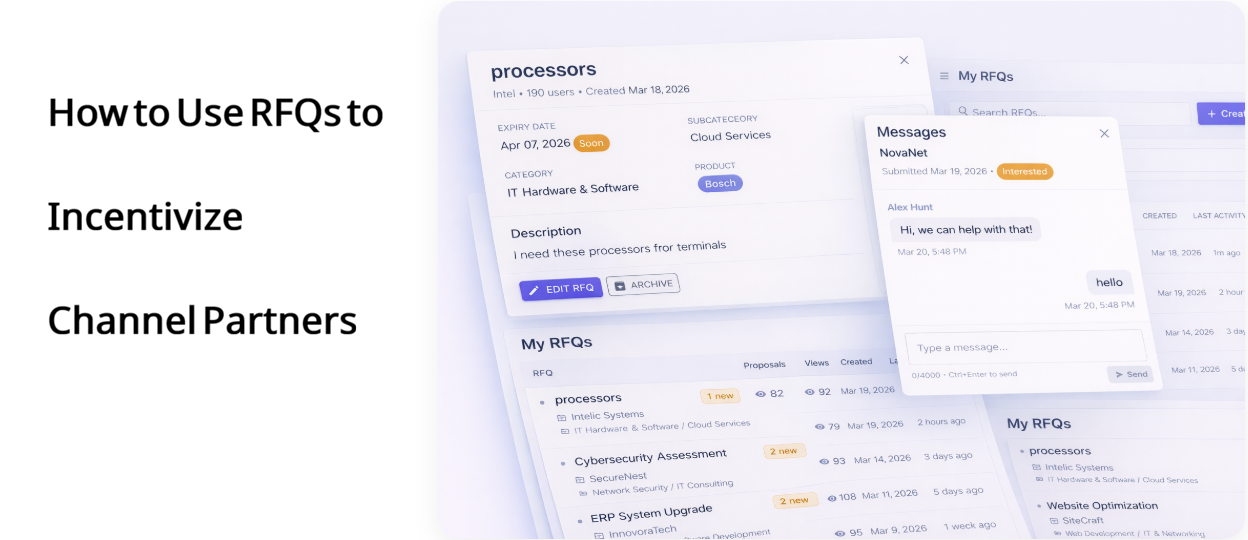
RFQ management software handles the operational layer: capturing inbound intent, matching it to qualified partners, distributing it with the right context, tracking response status, and flagging deals that have gone cold. The goal is to remove the channel manager as a manual bottleneck in every deal.
When evaluating tools in this category, look for:
- Automated routing logic based on partner attributes like location, expertise, and tier
- Partner-facing dashboards where partners can see, claim, and update RFQ status without contacting the vendor
- Deal registration integration so partners can register opportunities without duplicate data entry
- Vendor-side visibility into which partners are responding, which are ignoring leads, and which are closing
A platform that combines RFQ distribution with a full PRM gives you a single system of record for partner activity, rather than separate tools that need to be reconciled manually.
Keeping Partners Engaged After the RFQ
Sending an RFQ is the start of a process, not the end of one. Partners who receive leads but get no support during the sales cycle will close fewer deals and eventually disengage from the program entirely.
A few practices that keep partners active after an RFQ goes out:
Provide co-selling support on high-value deals. For deals above a certain size, offer to join a partner call or provide a technical resource. It signals that the vendor is invested in the outcome, not just passing leads over the fence.
Share competitive intelligence. If you know which competitors are in a deal, give your partner what they need to differentiate. This is especially relevant in cybersecurity and ITSM, where buyers often evaluate three to five vendors simultaneously.
Track outcomes and feed them back into routing. If certain partners consistently close RFQs in specific verticals or geographies, route more of those leads their way. If others are consistently non-responsive, address it directly or adjust their tier.
Make deal registration easy. If the process is complicated, partners will skip it. A simple, fast registration flow inside your partner portal removes friction and gives you the pipeline visibility you actually need.
FAQs
What is an RFQ in channel sales? In channel sales, an RFQ (request for quotation) refers to a qualified lead from a buyer who is actively evaluating solutions. It signals purchase intent rather than general interest, making it far more actionable for a channel partner than a typical inbound lead.
How do I distribute RFQs to the right channel partners? Match RFQs to partners based on geography, product expertise, and existing vendor relationships. Automated routing logic inside a PRM or channel platform removes the manual step and reduces the time between lead capture and partner notification.
What is RFQ management software? RFQ management software handles the distribution, tracking, and status management of qualified leads within a channel program. It automates routing, gives partners a self-service interface to claim and update deals, and gives vendors visibility into partner response rates and deal outcomes.
How fast should channel partners respond to an RFQ? A 48-hour response window is a reasonable standard for most programs. In competitive deals, faster is better. Some programs set a 24-hour window for high-priority leads and reroute automatically if no response is received.
How does intent data improve RFQ quality? Intent data identifies buyers who are actively researching or comparing solutions before they fill out a form. Routing that signal to a partner as a warm lead means the partner reaches the buyer earlier in the decision cycle — which improves close rates.
Can MSPs access RFQs directly, or do they have to wait for a vendor to route them? On a two-sided platform like Elioplus, MSPs and channel partners can access RFQs directly without waiting for a vendor to manually distribute a lead. This gives partners more control over their pipeline and reduces dependency on any single vendor relationship.
What should an RFQ include to be useful for a channel partner? A useful RFQ includes the buyer’s company name, industry, company size, the product or service category under evaluation, any stated budget or timeline, and notes on competing solutions if available. The more context the partner has upfront, the faster and more relevant their response will be.
Make RFQs a Repeatable Part of Your Channel Motion
RFQs are not a feature to configure once and forget. They are a repeatable mechanism for connecting buyers with the right partner at the right moment and they require consistent process, good tools, and ongoing attention to routing quality.
The vendors who get the most out of RFQs treat them as a core part of partner enablement, not an afterthought. They define qualification criteria, build routing logic, give partners the context they need to respond well, and track outcomes to improve over time.
If your channel program is still distributing leads manually or relying on partners to find their own opportunities, that is the gap worth closing first. A platform that surfaces intent data, routes qualified leads to the right partners, and manages the full partner relationship in one place removes most of the friction that slows deals down.