

Most partner programs stall not because of poor recruitment, but because of what happens after the contract is signed. A new reseller or MSP joins with genuine intent, then waits two weeks for portal access, gets a PDF welcome pack from 2023, and never registers a deal. That pattern repeats until your channel numbers look flat and you start questioning whether the partner was ever the right fit.
The problem is almost always onboarding, not the partner.
This guide covers the practices that actually shorten time-to-first-deal, reduce partner churn in the first 90 days, and give your channel team real visibility into who is activating and who is going dark.
Why Partner Onboarding Fails in IT Channel Programs
Most onboarding processes were designed for internal employees, not external businesses. An MSP joining your program already runs its own operations, manages its own clients, and has limited bandwidth to learn your systems. If your onboarding demands too much upfront, they deprioritize you in favor of vendors who make it easier.
Three failure patterns show up repeatedly:
- Too much information, too early. Dropping a full product catalog, pricing guide, and legal agreement on day one creates friction before the partner has any reason to care.
- No clear first action. If a partner logs into your portal and does not immediately know what to do next, they will not come back.
- No early win. Partners who do not register a deal or generate a lead within the first 60 days rarely become active contributors to your pipeline.
Fixing these patterns requires a structured onboarding sequence, not just better documentation.
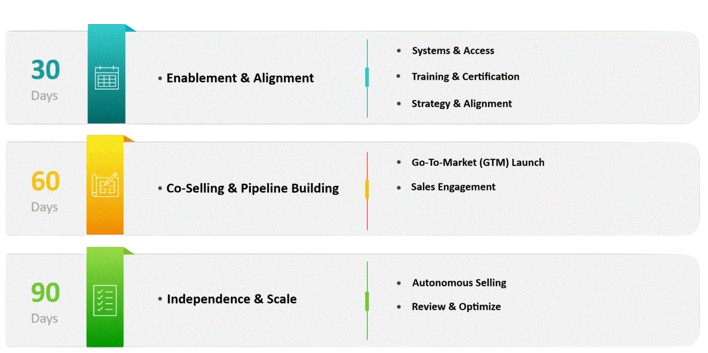
The 30-60-90 Day Activation Framework
A 90-day onboarding window is the right scope for IT vendor and MSP channel programs. Shorter cuts off before habits form; longer loses momentum.
Days 1 to 30: Access, Alignment, and First Contact
The first 30 days are about removing friction and establishing a working relationship. Get the partner into your portal, confirm their focus area matches your ICP, and schedule a kickoff call.
Key actions in this phase:
- Provision portal access within 24 hours of the agreement being signed. Every day of delay is a day the partner’s enthusiasm drops.
- Assign a dedicated channel contact. Even if that person is managing 20 other partners, the partner should know who to call.
- Run a 30-minute kickoff call focused on their business, not yours. Ask about their current customer base, active verticals, and which vendor relationships are already generating revenue. That tells you how to position your product in their context.
- Set a 30-day goal together. One registered opportunity, one joint prospect call, or one completed certification module. Make it specific and achievable.
Days 31 to 60: Enablement and First Pipeline Activity
By day 31, the partner should have everything they need to start selling. This phase is about moving from setup to activity.
- Deliver targeted enablement, not everything at once. A cybersecurity MSP does not need your full product suite on day 31. Start with the two or three use cases most relevant to their customer base.
- Make deal registration frictionless. If registering a deal takes more than five minutes, partners skip it. Your PRM should surface deal registration prominently and require minimal fields for the initial submission.
- Send a co-selling resource pack. One-page sell sheets, competitive objection handling notes, a short demo script. Keep it practical.
- Check in at day 45. A brief async update or a 15-minute call. Ask what is blocking them. The answers will tell you more about your onboarding gaps than any internal review.
Days 61 to 90: Momentum and Tier Clarity
The final phase converts early activity into repeatable behavior and sets expectations for what the relationship looks like at scale.
- Review pipeline together. Any registered deals should have a clear next step. If there are none, diagnose why before the 90-day mark.
- Introduce tier structure and incentives. Once a partner has real product context and some sales experience, the conversation about tiers and revenue targets lands very differently than it does on day one.
- Confirm the ongoing communication. Quarterly business reviews, monthly deal reviews, or a shared Slack channel, whatever fits the partner’s size and activity level. Agree on this before day 90.
What Your Partner Portal Needs to Support Fast Activation
The portal is where onboarding either accelerates or collapses. A portal that makes partners hunt for information or submit support tickets to complete basic tasks destroys the experience you built during recruitment.
At minimum, new partners should find:
- A guided onboarding checklist visible on first login
- Deal registration accessible without navigating through unrelated sections
- A content library organized by sales stage, not by product feature
- A direct line to their channel contact
Platforms that bundle onboarding workflows into the PRM itself reduce the manual coordination load on your channel team significantly. Elioplus’s PRM includes partner portals, deal registration, onboarding workflows, and tier management in one place, partners move through onboarding steps without switching between tools or waiting on email threads. The free PRM tier lets early-stage IT vendors stand up a proper onboarding experience without a large upfront commitment.
Segmenting Onboarding by Partner Type
Not every partner onboards the same way. A national distributor like TD SYNNEX operates differently from a 10-person MSP focused on a single vertical. Applying the same onboarding sequence to both wastes time for the distributor and overwhelms the MSP.
Segment your onboarding tracks across at least two dimensions:
Partner size and capacity. Larger partners with dedicated sales teams can absorb more enablement content faster. Smaller MSPs need a tighter, more guided experience with fewer decisions to make early on.
Partner type. A reseller focused on volume transactions needs fast deal registration and margin clarity. A services-led MSP needs use case depth and co-selling support. A referral partner needs almost no product training but does need a clean lead submission process.
Building two or three distinct onboarding tracks inside your PRM, rather than one generic flow, meaningfully improves activation rates across your partner base.
Measuring Onboarding Effectiveness
The metrics that matter for partner onboarding are not the same ones you track for direct sales.
Track these at the program level:
- Time to first deal registration: How many days from portal access to the first registered opportunity? A reasonable target is under 45 days for active partners.
- 30-day portal login rate: If fewer than 70% of new partners log in within 30 days, your provisioning or welcome communication has a problem.
- 90-day activation rate: What percentage of partners recruited in a given quarter register at least one deal within 90 days? This is the clearest signal of whether your onboarding is working.
- Enablement completion rate: For partners who complete at least one certification or training module, how does their deal registration rate compare to those who do not? This tells you whether your enablement content is actually driving sales behavior.
Review these quarterly. If 90-day activation rates are below 30%, the issue is almost always onboarding, not partner quality.
Common Mistakes to Avoid in 2026
A few patterns persist in IT channel programs despite being well-documented problems.
Treating onboarding as a one-time event. Onboarding ends when the partner is consistently active, not when they receive their welcome email. Build a 90-day sequence, not a single touchpoint.
Skipping the kickoff call for smaller partners. The partners most likely to go dark are the ones who never had a real conversation with your team. A 20-minute call in the first week pays for itself many times over.
Relying on a CRM to manage partner workflows. CRMs track contacts and deals, but they are not built for channel-specific processes like deal registration, tier management, or co-selling coordination. A purpose-built PRM handles these without workarounds.
Asking for co-marketing before the partner has closed anything. Case studies and joint webinars come after the partner has generated revenue, not before.
FAQs
What is partner onboarding in a channel program? Partner onboarding is the structured process of activating a newly recruited reseller, MSP, or distributor so they can start generating revenue. It typically covers portal access, product enablement, deal registration setup, and early pipeline activity — usually within the first 60 to 90 days.
How long should partner onboarding take? For most IT vendor programs, 90 days is the right target. The first 30 days focus on access and alignment, days 31 to 60 on enablement and first pipeline activity, and days 61 to 90 on momentum and tier clarity. Partners who do not register a deal within 90 days rarely become consistently active.
What is a good 90-day partner activation rate? A healthy target is 40% to 60% of newly recruited partners registering at least one deal within 90 days. Rates below 30% typically point to onboarding friction, not partner quality issues.
Do I need a PRM to run effective partner onboarding? Not for a program with five or fewer partners — but it becomes important quickly beyond that. Without a PRM, onboarding relies on email threads and spreadsheets, which do not scale and give you no visibility into partner activity. Elioplus offers a free PRM tier, so there is no cost barrier to starting with a proper system.
What is the most common reason new channel partners go inactive? A lack of early momentum. Partners who do not register a deal or receive a qualified lead in the first 60 days deprioritize the vendor relationship in favor of programs where they are already generating revenue. A structured onboarding sequence with a clear first-action goal directly addresses this.
How do I onboard different types of partners differently? Build two or three onboarding tracks inside your PRM based on partner type and size. A volume reseller needs fast deal registration and margin clarity. A services-led MSP needs use case depth and co-selling support. A referral partner needs a clean lead submission process and minimal product training. One generic flow applied to all three will underserve each of them.
Should I use my CRM for partner onboarding workflows? CRMs are built for direct sales. They track contacts and opportunities but do not natively support channel-specific processes like deal registration, partner tier management, or co-selling coordination. Using a CRM for partner onboarding creates workarounds that break down as your program scales. A purpose-built PRM handles these workflows without the customization overhead.
Slow partner activation is a structural problem with a structural fix. Build a 90-day onboarding sequence, segment it by partner type, give partners a clear first action, and measure activation rates quarterly. The vendors who do this consistently are the ones whose channel programs compound over time.