
Routing a lead to the wrong partner is one of the most expensive mistakes in channel sales. The deal stalls, the partner loses confidence, and the buyer moves on. Yet most IT vendors still distribute leads manually, a spreadsheet here, a Slack message there, and wonder why partner-sourced revenue underperforms.
In 2026, lead distribution is a defined process, not an afterthought. Here’s how to build one that holds: what routing criteria actually work, where most programs break down, and what your PRM should be handling automatically.
Why Lead Distribution Fails in Most Channel Programs
The failure usually starts before a single lead gets routed. Vendors build a partner program, sign up resellers, and treat lead distribution as a sales ops task rather than a channel strategy decision.
Three patterns repeat across underperforming programs:
No routing logic. Leads go to whoever asks first, or to the partner the channel manager knows best. Geography, technical fit, and partner capacity never enter the equation.
No visibility. Once a lead leaves the vendor’s CRM, it disappears. No tracking, no follow-up trigger, no way to know if the partner is actually working it.
No accountability structure. Partners receive leads with no acceptance deadline and no consequence for going dark. The vendor has no data to reallocate leads to partners who actually perform.
Each of these is a process problem. Each one is solvable with the right PRM setup.
The Routing Criteria That Actually Matter
Good lead distribution starts with matching, not just assignment. Before you route anything, define the attributes that determine which partner is the right fit for a given opportunity.
Geography and Territory
The most basic filter and the most commonly misconfigured. Territory rules need to account for where the buyer is headquartered, where the deal will be serviced, and whether the partner has active coverage in that region. A cybersecurity reseller based in Germany may have zero capacity to service a deal in Southeast Asia, even if they technically cover “EMEA.”
Technical Specialization
If your product requires implementation expertise, ITSM configuration, data management integration, anything with real technical depth, routing to a generalist MSP wastes the lead. Filter by certified partners first, then by partners who have closed similar deals before.
Partner Tier
Tier structure exists for a reason. High-value leads belong with partners who have the training, resources, and commitment level to close them. Routing a six-figure enterprise deal to a newly onboarded silver-tier partner is a setup for failure on both sides.
Capacity and Responsiveness
A partner who consistently accepts leads but never moves them past the first call is not a good routing target, regardless of their tier. Track acceptance rates, time-to-first-contact, and win rates per partner. Let that data drive your routing decisions.
Existing Relationships
If a partner already has a relationship with the target account, a prior deal, an active contract, a warm introduction, that context should override other routing logic. Your PRM should surface it.
How to Structure Your Lead Distribution Process
Once your routing criteria are defined, the process needs four components to function reliably.
1. Centralized Lead Intake
Every lead, from your website, a marketing campaign, an inbound inquiry, or a partner referral, needs to enter a single system. If some leads live in Salesforce, others in a spreadsheet, and others in someone’s inbox, your routing logic has no foundation to work from.
A PRM with built-in lead distribution solves this by making the partner portal the single point of intake and assignment. Partners see their leads in one place. You see the full pipeline in one view.
2. Defined Acceptance Windows
Set a hard deadline for lead acceptance, 24 to 48 hours is standard across most IT channel programs. If a partner doesn’t accept within that window, the lead automatically routes to the next qualified partner. No manual intervention, no awkward conversations.
This rule alone recovers a significant number of leads that would otherwise go cold.
3. Deal Registration Integration
Lead distribution and deal registration are two sides of the same workflow. When a partner accepts a lead, they should be able to register the deal immediately, locking in their protection and signaling intent to pursue. This shields the partner from channel conflict and gives you real pipeline visibility.
Without deal registration tied to lead distribution, you risk two partners working the same account at the same time, which damages both the relationship and the deal.
4. Reporting and Reallocation
Track every lead by partner: acceptance rate, time to first contact, stage progression, and outcome. Review monthly. Partners who consistently underperform on routed leads should receive fewer until performance improves. Partners who close at high rates should get priority routing on high-value opportunities.
This isn’t punitive, it’s how you build a productive channel rather than just a large one.
Where Your PRM Fits Into This
A CRM tracks your direct sales pipeline. It’s not built for partner-facing workflows. Routing logic, deal registration, partner portals, and tier-based access controls require purpose-built tooling.
That’s exactly what PRM software handles. Elioplus includes lead distribution as a core component of its PRM, alongside deal registration, partner onboarding, and tier management, all in one platform. Vendors can route leads based on defined criteria, track acceptance and progression inside the portal, and tie lead activity directly to deal registration workflows.
The free PRM tier means you can start building this infrastructure before you have a large partner base. You don’t need 50 active partners to justify a structured process; you need a structured process to get to 50 active partners.
Handling Lead Conflicts and Channel Conflict
Channel conflict is the most common objection partners raise when they feel underserved. It usually takes one of two forms: two partners competing on the same account, or a partner competing with your direct sales team.
Both are preventable with clear rules.
For partner-versus-partner conflict, deal registration with first-in-wins logic is the standard fix. The first partner to register a deal gets protection for a defined period. Your PRM enforces this automatically.
For partner-versus-direct conflict, you need a documented policy that defines which accounts are partner-led, which are direct-led, and what happens when a lead lands in a gray zone. Post it in your partner portal so there’s no ambiguity.
Partners who trust your conflict resolution process engage more actively. Partners who feel exposed disengage quietly and you usually don’t find out until they stop registering deals.
Scaling Lead Distribution as Your Program Grows
Programs with five to fifteen partners can manage distribution with relatively simple rules. Past 30 or 50 partners, the complexity compounds: more territories, more specializations, more tier levels, more edge cases.
The vendors who scale well-built the process correctly early. Routing logic documented, acceptance windows enforced, reporting in place. When they add partners, the system absorbs the volume without requiring proportional increases in channel management headcount.
Vendors who scaled without process spend most of their time firefighting, chasing partners for updates, resolving conflicts manually, reconstructing pipeline data from email threads.
If your program is still early, now is the right time to set this up. If it’s already growing and you’re feeling the friction, a PRM with built-in lead distribution is the fastest path to getting it under control.
FAQs
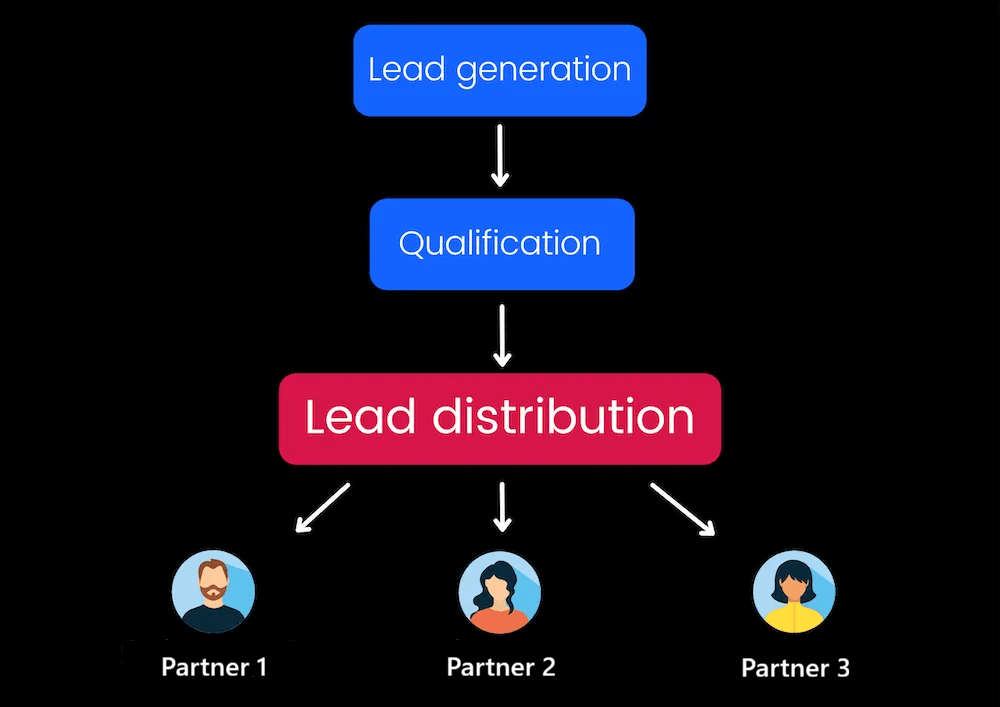
What is lead distribution in channel sales? Lead distribution in channel sales is the process of routing inbound or vendor-generated leads to the most appropriate channel partner for follow-up and closing. It involves matching leads to partners based on criteria like geography, technical specialization, partner tier, and capacity.
How do I prevent two partners from working the same lead? Deal registration with first-in-wins logic prevents this. The first partner to register a deal in your PRM receives protection for a defined period. Your PRM enforces the rule automatically, removing the need for manual arbitration.
What routing criteria should I use for lead distribution? The most reliable criteria are geography and territory, technical specialization, partner tier, historical performance (acceptance rate, win rate), and existing relationships with the target account. Use all of them together rather than relying on a single filter.
Do I need a PRM to manage lead distribution, or can I use a CRM? A CRM tracks your direct sales pipeline and isn’t designed for partner-facing workflows. Lead distribution, deal registration, partner portals, and tier management require purpose-built PRM functionality. Using a CRM for channel workflows creates visibility gaps and manual overhead.
What happens if a partner doesn’t accept a routed lead? Set a defined acceptance window, typically 24 to 48 hours. If the partner doesn’t respond within that window, the lead should automatically route to the next qualified partner. This prevents leads from going cold due to partner inaction.
How do I know which partners to prioritize for lead routing? Track acceptance rates, time-to-first-contact, stage progression, and win rates per partner over time. Partners who consistently perform well on routed leads should get priority routing on high-value opportunities. Partners who accept leads but don’t advance them should receive fewer until performance improves.
When should I start using a structured lead distribution process? From the moment you have more than one active partner. Even with a small partner base, a structured process prevents conflict, builds partner trust, and creates the data foundation you’ll need as the program scales.
A structured lead distribution process is one of the clearest signals to your partners that you’re serious about the channel. It protects their deals, gives them confidence in your program, and gives you the pipeline visibility to make smarter decisions. Start with the right criteria, enforce acceptance windows, tie it to deal registration, and track the results.