
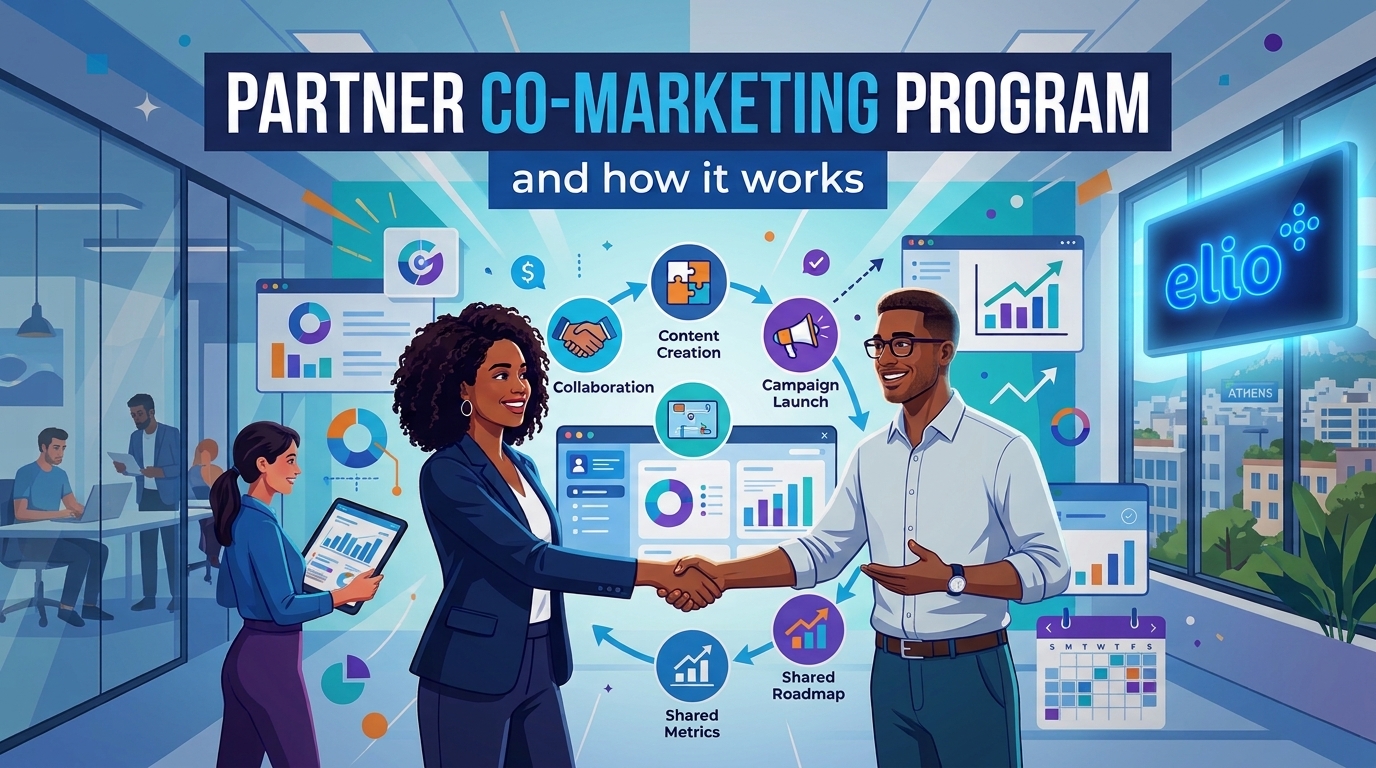
A co-marketing program is one of the most practical investments an IT vendor can make in its channel. Joint campaigns with resellers extend your reach into markets that would be too costly to enter alone – and give your partners the marketing firepower they typically lack. The arrangement benefits both sides, but only when it’s built with intention.
This article walks through how IT vendors design, fund, and operate partner co-marketing programs that actually produce pipeline – not just PDFs collecting dust in a partner portal.
What a Partner Co-Marketing Program Actually Is
At its core, a co-marketing program is a formal arrangement where a vendor and one or more resellers or MSPs plan and execute marketing activities together. The vendor typically brings funding, creative assets, messaging, and sometimes campaign management support. The partner brings local market access, customer relationships, and on-the-ground execution.
The word “joint” matters. This isn’t a vendor pushing a campaign at a partner and asking them to forward it. It’s a shared effort – shared accountability, shared goals, and ideally shared visibility into results.
Co-marketing is also distinct from co-selling, where two parties collaborate on a specific deal. Co-marketing happens earlier in the funnel, generating awareness and demand before any deal is on the table.
Why IT Vendors Invest in Co-Marketing With Resellers
Resellers and MSPs have something most vendors struggle to build quickly: trusted relationships with end customers in specific verticals, geographies, or company sizes. A mid-market MSP focused on healthcare has years of credibility with IT directors at regional hospital networks. A vendor trying to break into that segment from scratch faces a long, expensive road.
Co-marketing lets you borrow that credibility. Your product gets introduced through a voice the customer already trusts.
The value is equally clear from the partner’s side. Most resellers don’t have dedicated marketing teams. They’re good at selling and delivering services, but generating demand is a different skill set. When you show up with campaign templates, ad budgets, and content they can put their name on, you remove one of the biggest barriers to their growth.
When it works, the effect compounds. Partners who generate pipeline through co-marketing become more committed to your product – they invest more in training, certifications, and selling your solution because they have real skin in the game.
The Core Components of a Funded Co-Marketing Program
Market Development Funds
Market development funds – commonly called MDF – are the financial backbone of most co-marketing programs. A vendor allocates a budget to each qualifying partner, which the partner can spend on approved marketing activities. Eligible activities vary by program but typically include webinars, local events, paid digital campaigns, email campaigns, and content development.
MDF programs work best when they’re easy to access and fast to approve. Partners who wait six weeks for approval and then face a 20-page reimbursement form will stop using the program. Simplicity and speed are the design goals.
Co-Op Advertising Funds
Co-op funds work similarly to MDF but are tied directly to a partner’s sales performance. Partners earn a percentage of their revenue with you as a credit toward joint advertising – the more they sell, the more co-op budget they accumulate.
It’s a strong incentive structure because it rewards partners who are already performing. The downside is that newer or smaller partners, who often need marketing support the most, earn less co-op at exactly the moment they need more help. Many vendors run MDF and co-op in parallel to close that gap.
Campaign-in-a-Box Assets
Funding alone isn’t enough. Most resellers don’t know how to build a campaign from scratch – and they shouldn’t have to. Effective co-marketing programs provide ready-to-deploy campaign kits: email templates, social copy, landing page copy, ad creative, and a suggested timeline.
The partner customizes these with their logo, contact details, and any local messaging, then launches. You get consistent brand representation across dozens or hundreds of partners without managing each one individually.
Concierge or Managed Campaign Services
Some vendors go further and offer to run campaigns on behalf of partners – either fully or in a co-managed model. This is especially valuable for smaller MSPs who have the customer relationships but genuinely can’t spare staff time for campaign execution.
Managed services add cost on the vendor side, but they also increase utilization. MDF that gets spent generates pipeline. MDF that sits unused because partners can’t execute produces nothing.
How to Structure Your Co-Marketing Program
Define Eligibility and Tiers
Not every partner warrants the same level of co-marketing support. A partner who has completed product certification, maintains a dedicated sales resource, and consistently hits revenue thresholds is a better investment than one who signed up but has never closed a deal.
Tier your program accordingly. Gold or Platinum partners might receive higher MDF allocations, access to managed campaign services, and priority approvals. Silver partners get campaign-in-a-box materials and a smaller fund. Entry-level partners get self-service assets only.
Clear tiers give partners something to work toward and protect your budget from being spread thin across partners who aren’t yet positioned to use it well.
Set Goals and Metrics Upfront
Every co-marketing activity should have a defined goal before it launches. Is the campaign designed to generate leads? Drive event registrations? Build awareness in a new vertical? The goal determines what you measure.
Common metrics for co-marketing programs include:
- Leads generated per campaign
- Cost per lead by partner tier and campaign type
- Pipeline attributed to co-marketed activities
- MDF utilization rate
- Time from campaign launch to first qualified opportunity
Without measurement, you can’t improve the program – and you can’t make the case internally for continued investment.
Build a Simple Approval and Reimbursement Process
The most common reason MDF programs fail is friction. Partners submit requests and wait. They complete campaigns and wait months for reimbursement. Eventually, they stop trying.
Design your approval process to respond within five business days for standard requests. For pre-approved campaign types, consider automatic approval. For reimbursement, ask only for what you actually need to verify the activity happened – a screenshot, an invoice, an attendee list. Don’t require documentation that exists only to satisfy a compliance checkbox.
Communicate Regularly With Partners
Partners who don’t know what’s available won’t use it. Send a quarterly update covering available funds, new campaign assets, and any program changes. Assign a channel marketing manager or partner success contact partners can reach when they have questions.
Regular communication also surfaces what’s working. If a particular email sequence is generating strong results for partners in the financial services vertical, share that insight across the program. Everyone benefits, and the program gets sharper over time.
Common Mistakes Vendors Make With Co-Marketing Programs
Overcomplicating the approval process: If partners need to submit a formal proposal, wait for committee review, and resubmit after revisions, most won’t bother. Keep approvals fast and criteria clear.
Providing assets that don’t convert: Generic brand awareness content isn’t co-marketing – it’s brand
advertising with two logos on it. Campaign assets should be designed to drive a specific action from a specific audience. Specificity is what makes campaigns work.
Failing to track attribution: If you can’t connect co-marketing spend to pipeline, you can’t justify the budget. Build tracking into every campaign from the start – UTM parameters, dedicated landing pages, partner-specific promo codes. Know what’s driving results.
Treating all partners the same: A large national reseller and a three-person MSP have different needs and different capacities. A one-size-fits-all program underserves both. Segment your approach.
Not following up on leads: This one falls on both sides. Vendors sometimes generate leads through
co-marketing and hand them off with no follow-up support. Partners sometimes receive leads and don’t act quickly. Define a lead follow-up SLA as part of the co-marketing agreement.
How Technology Supports Co-Marketing Program Management
Running a co-marketing program across dozens or hundreds of partners is operationally complex. You need to track fund allocations, approve requests, distribute assets, measure campaign performance, and communicate at scale. Spreadsheets and email threads break down fast.
A partner relationship management platform centralizes this work. Partners log in to check available
funds, browse and customize campaign assets, submit activity requests, and upload proof of execution for reimbursement. Vendors get a dashboard view of program utilization, campaign activity, and pipeline attribution.
Elioplus gives IT vendors the infrastructure to manage channel partners at this level of detail. The platform supports partner recruitment, relationship management, and the kind of structured program management that makes co-marketing programs actually run. If you’re building or scaling a channel program and want to move beyond spreadsheets, it’s worth seeing what a purpose-built PRM can do.
Aligning Co-Marketing With Your Broader Channel Strategy
A co-marketing program doesn’t exist in isolation. It works best when it’s connected to your partner recruitment, onboarding, and enablement efforts.
Partners who are well-onboarded and trained on your product are better positioned to execute co-marketing campaigns. They understand the value proposition, can answer customer questions, and can close the leads a campaign generates. Investing in co-marketing with partners who haven’t completed basic product training is likely wasted spend.
Co-marketing should also inform your recruitment strategy. If partners in a particular vertical or geography consistently generate strong pipeline through joint campaigns, that’s a signal to recruit more partners in that segment. The data from your co-marketing program is intelligence for your broader channel growth strategy.
FAQs
What is the difference between MDF and co-op in a co-marketing program? MDF is typically allocated by the vendor based on partner tier, business plan, or strategic priority. Co-op funds are earned as a percentage of the partner’s sales revenue. MDF is proactive and strategic; co-op is performance-based. Many vendors use both.
How much should an IT vendor budget for a co-marketing program? A common starting point is 2 to 5 percent of channel revenue allocated to partner marketing support. The right number depends on your growth goals, the maturity of your partner ecosystem, and how much execution support you provide alongside the funds.
What activities are typically eligible for MDF spending? Common eligible activities include webinars, virtual and in-person events, paid search, social media advertising, email campaigns, content development, and trade show participation. Each vendor defines its own approved list – being generous here tends to increase utilization.
How do you prevent MDF from being misused? Require proof of execution before reimbursing funds. Screenshots of a live campaign, an invoice from an event venue, or a webinar attendee list are usually sufficient. You don’t need an audit-level review for every activity, but some verification protects the program.
How do you measure the ROI of a co-marketing program? Track leads generated, pipeline created, and revenue closed that can be attributed to co-marketed activities. Compare that against total co-marketing spend, including internal resources. Over time, you should be able to calculate cost-per-opportunity and cost-per-closed-deal by partner tier and campaign type.
What should a co-marketing agreement with a reseller include? At minimum: campaign goals, each party’s responsibilities, budget allocation and reimbursement process, timeline, how leads will be shared and followed up on, and how results will be measured. A short, clear document beats a lengthy contract neither party reads carefully.
How do smaller MSPs participate in co-marketing programs if they lack marketing staff? Vendors
can address this by providing campaign-in-a-box kits that require minimal customization, offering managed campaign services where the vendor handles execution, or connecting partners with a marketing agency at a subsidized rate through the program. Removing execution barriers is the key to getting smaller partners to participate.
Build a Program Worth Participating In
The best co-marketing programs are ones partners actively want to use – simple processes, useful assets, fast approvals, and clear evidence that the investment pays off. When partners see that co-marketing with you generates real pipeline, they prioritize your product over competitors.
Start with a small group of partners, run a few campaigns, measure everything, and iterate. The structure you build in the first year becomes the foundation for a program that scales as your channel grows.
If you are not aware of how to build a successfull partner program for your IT company then we have plenty of partners that can definitely help you on that. Please let us know by sending a message through our Contact Us form here (https://elioplus.com/contact-us) and mention “I would like to learn more about how to create a successfull partner program”.
After you submit your request, someone at Elioplus’ team will connect you with the appropriate partner of ours to talk on that.