
Most channel managers get fixated on signing new channel partners. They focus almost exclusively on hitting specific numbers on their desired locations and get frustrated when their new partners don’t register deals in the coming months. Given the fact that many channel managers have no business background or experience in the field it is somewhat expected.
Signing a new channel partner feels great, but it’s only the beginning.
Too often, the onboarding process goes one of two ways. Either you dump a mountain of product PDFs and portal logins on them and expect that they figure it out, or you smother them with endless, theoretical training sessions that never actually lead to a pipeline. Before you know it, many months have gone by and your new partner is completely ghosting your messages when you touch base.
The secret to a successful B2B SaaS partnership is a structured, predictable roadmap that turns new partners first into a demand generation and ultimately a revenue generation network. But because no two SaaS products are the same, your approach can’t be one-size-fits-all. A partner selling a high-volume, short sales cycle product needs a completely different onboarding process than a partner trying to promote a nine-month enterprise ERP cycle.
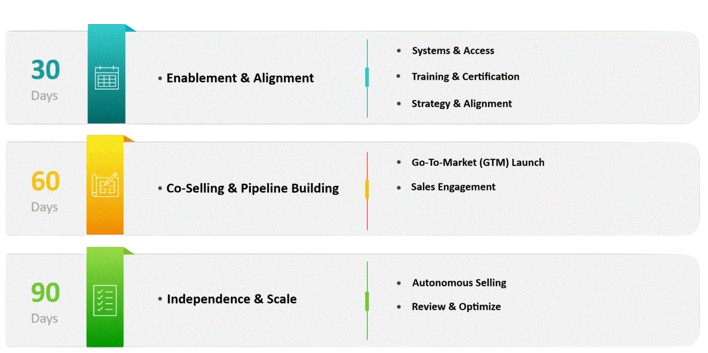
In this guide, we’re breaking down a step-by-step 30-60-90 day onboarding checklist built specifically for IT channel managers.
⏱️ Phase 1: Days 1–30 | Enablement & Alignment
Goal: The first month focuses on getting the partner’s team up to speed. The goal is internal readiness, not immediate sales.
🛠️ Systems & Access: Create a partner a partner account in your Partner Relationship Management portal and provide access to the marketing asset library, sales decks and establish a communication channel. If your PRM offers a real-time messaging and is integrated with other applications like Slack for example it will help you to create a centralized hub for all your communications.
🎓 Training & Certification: Train partner sales and technical teams on your SaaS platform’s core features, use cases, and ideal customer profile (ICP). Given that your partner may be in a different time zone, try to record product videos that they can utilize at their own time and give them a detailed walk-through of the Deal Registration process. Create training courses for engineers and a certification process to track their progress.
📈 Strategy & Alignment: Sit down with partner leadership to define clear Key Performance Indicators (KPIs), revenue targets, and schedule bi-weekly meetings.
Examples: For simple SaaS products with short sales cycles, you can focus videos that your partners should complete by day 20 and for complex sales (enterprise ERP) you should focus on technical certifications and architect training. The partner learns how to handle complex integrations and security objections.
🚀 Phase 2: Days 31–60 | Co-Selling & Pipeline Building
Goal: Marketing activation and generating the first opportunities.
📣 Go-To-Market (GTM) Launch: Identify the partner’s top 10 existing customers that fit your ICP and launch a co-branded marketing campaign (email sequence, webinar, etc.). Through your partner portal, provide marketing collateral for the partner to distribute to their database.
🤝 Sales Engagement: Incentivize your partners to register their first 3 to 5opportunities through your partner portal to start the momentum. Have the channel manager or an internal account executive (AE) to support the partner’s initial discovery calls and demos as a safety net and to pin point issues that need improvement.
Examples: For short sales cycle, aim to close the first transactional deal by day 45 through a streamlined, low-touch sales process. For complex sales cycle, map accounts together. Identify 2 or 3 high-value enterprise targets. Spend this month navigating discovery calls, scoping technical requirements, and building custom Proofs of Concept (PoCs).
💰 Phase 3: Days 61–90 | Independence & Scale
Goal: By the third month, the partner should transition into a self-sufficient revenue generator.
🦅 Autonomous Selling: The partner takes the lead on presentations, demos, and negotiations, using the vendor only for high-level executive support or deep technical questions.
📊 Review & Optimize: Look back at the first 60 days of data. Assess the sales cycle, close rates, and portal usage to identify bottlenecks. Provide tier benefits, specialized SPIFFs (sales incentives), or co-marketing funds (MDF) to reward active engagement and accelerate growth.
Examples: For short sales cycle, focus on tracking MRR, how to reduce churn and establishing a feedback loop. For complex sales cycle, measure pipeline value and keep track of how your partner handles the mid-funnel stages.
Conclusion
At the end of the day, a partner onboarding checklist is just a paper document. You can build the most beautiful template in the world, but if you don’t actively guide your partners through it, it’s just another list that you share with your management that it won’t produce any tangible results.
Remember, the goal of the first 90 days is to create a process and incentivize your new partners to register their first deals. Whether you are offering a simple SaaS platform or a deep-tech product, focus heavily on building early momentum. Treat your partners like an extension of your internal team, give them the exact tools they need to succeed, and watch your indirect revenue scale.